

Workspace
A workspace is the container for everything: members, subscription plan, API keys, credits, chats, projects and files. Every API call and every Studio message is scoped to exactly one workspace. You can belong to multiple workspaces (switch via the top-left selector in the app).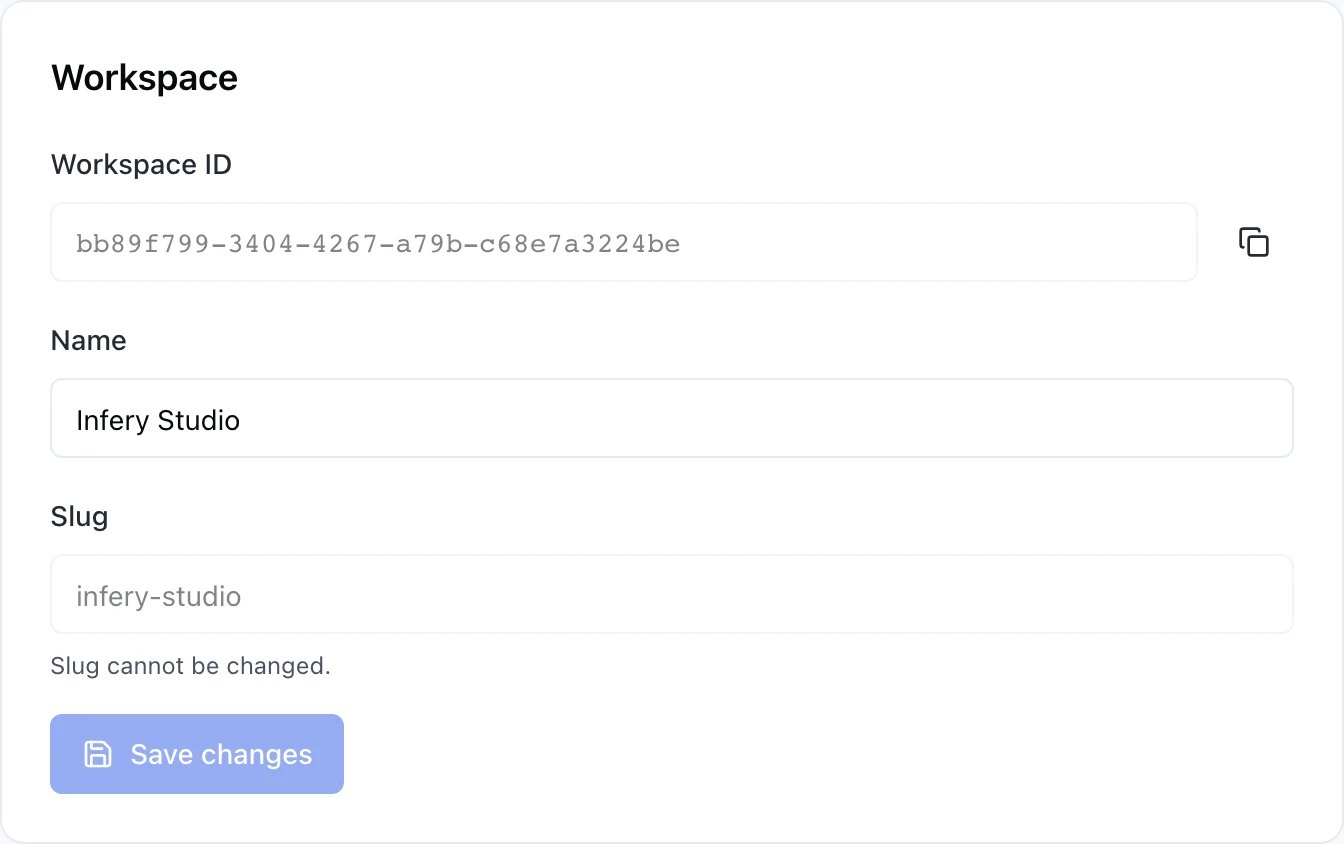
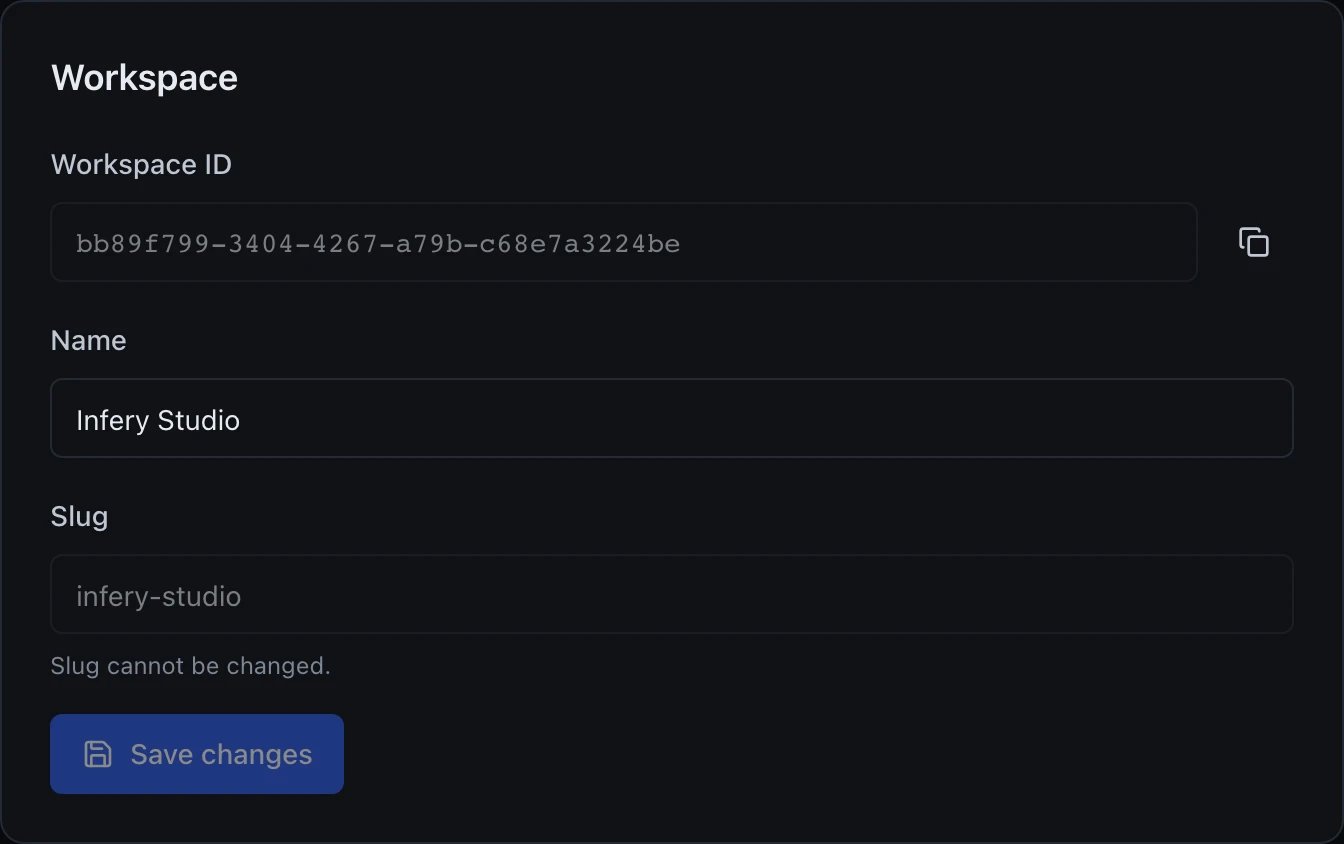
Workspace settings: the id the API wants, the name people see, and the slug that never changes
Members and roles
Each member has a role that controls what they can do:
There is exactly one owner per workspace. See Members and roles for details.
Credits
Everything on Infery is priced in credits. 1 credit ≈ $0.01. Every chat token, every generated image, every second of voice, every workflow step is metered to the same balance — no per-provider invoices to juggle. Two sources of credits:- Monthly plan credits — granted at the start of each billing cycle. Unused ones roll over up to three months’ worth of your allowance on every paid plan; the excess expires at renewal.
- Topups — one-off purchases that never expire.
Studio
The Studio is the in-browser product surface: chats, projects, file uploads, generations, sharing with teammates, bookmarks. If you’re evaluating or exploring — this is where you live. Learn more: Studio overview.API
The API is how you build with Infery in production, authenticated with a Bearer token (inf_live_…).
Where OpenAI has a route, ours is compatible at the wire level — POST /v1/chat/completions, POST /v1/embeddings, POST /v1/images/generations, POST /v1/files. Point the OpenAI SDK at our base URL and it works unchanged. Modalities OpenAI has no route for — video, music, 3D, upscaling, tools and workflows — are our own, and follow the same conventions: same key, same error shape, same credit balance.
Both Studio and API share the same credit balance and same catalogue. A Studio message and an API call cost the same.
Start: API introduction.
Models
More than 1,400 models are callable right now, from nearly 200 owners — OpenAI, Anthropic, Google, xAI, DeepSeek, Alibaba, Black Forest Labs, MiniMax, ElevenLabs, Suno and the rest — across eleven modalities: text, image, video, audio, music, speech-to-text, vision, 3D, upscale, embedding and rerank. A request names a model by slug (gpt-5.2, claude-opus-5, gemini-3.5-flash, nano-banana-pro). The slug is the stable part: which provider serves it is routing, and that can change without your code changing. owned_by on GET /v1/models reports who made the model, never who is serving it.
What a model accepts beyond the shared fields is the model’s own business — an
image model declares its sizes, a speech model its voices. _infery.allowed_params
on GET /v1/models is the authoritative list, and the
capability flags tell you which models stream, take
images, honour tools or do JSON mode. Branch on the flag, never on the name.
Browse by modality at Model catalog, or see Owners for who has what.
Tools
Most of the work around a model is not inference. A tool does exactly one thing, deterministically, for a fixed price: trim a video, extract text from a PDF, pack an archive, run a Python snippet. No prompt, no sampling, no variance between two identical calls — and no inference pricing for whatffmpeg can do.
Tools are listed by GET /v1/tools and invoked with POST /v1/capabilities/{id}/run.
See the Tool catalog.
Workflows
A workflow chains model calls, tools, HTTP requests and media transforms into one JSON definition that runs on our side. One request in, one result out — a ten-step workflow is one HTTP request, not ten. Steps read each other’s output by path (bindings), and an artifact a step produces is re-hosted in your workspace and handed onward by reference rather than re-uploaded by you.POST /v1/workflows/estimate prices a definition before it runs. Runs can be
synchronous, async-and-polled, or scheduled. Author them as
JSON through the API or visually in the editor — both write the same definition.
Start: Workflows.
Memory
A Studio chat does not start from nothing. Before answering, the assistant pulls in memory (durable facts learned about you — “prefers TypeScript”) and excerpts (passages from your earlier chats that resemble what you just asked). Both are scoped to you alone, whatever anyone’s sharing settings say. What was recalled is shown above each reply, and Settings → Profile → Memory lists every fact with the chat it came from, deletable one by one. Details: Memory and context.Files
Two kinds of files, kept separate:- Studio attachments — dropped into a chat message. They inherit that chat’s sharing scope: whoever can read the chat can read the attachment.
- API files — uploaded via
POST /v1/fileswith OpenAI-compatible semantics. The id isfile_-prefixed (not a UUID) and is referenced from chat completions as a content block.