> ## Documentation Index
> Fetch the complete documentation index at: https://docs.infery.ai/llms.txt
> Use this file to discover all available pages before exploring further.
# Scheduling a workflow
> Run a stored workflow on a repeating schedule, or once at a future time — and what turns a schedule off.
A schedule starts a stored workflow without anyone asking — every weekday at
09:00, every fifteen minutes, or once at a time you pick.
Schedules start runs in the same **async** mode as
[`mode: "async"`](/workflows/running) — the tick enqueues a run and returns.
Whether the workflow then succeeds is a separate question, and the schedule
reports on it separately.
## Setting one up
### 1. Open the workflow's menu
In the workflows sidebar, hover the workflow and open its **⋯** menu, then choose
**Schedule**. You need the same permission as editing the workflow — a schedule
spends credits later and unattended, so read access is not enough.
### 2. Choose repeating or once
**Repeating** fires until you turn it off. **Once** fires a single time at an
instant you pick and then retires itself.
### 3. Say how often
For a repeating schedule, pick a shape — every N minutes, every N hours, daily,
on chosen weekdays, or on a day of the month — then set the time. Options your
plan does not allow are greyed out rather than hidden, so you can see what an
upgrade would buy.
For a one-time schedule, pick a date and time. Past instants are not offered.
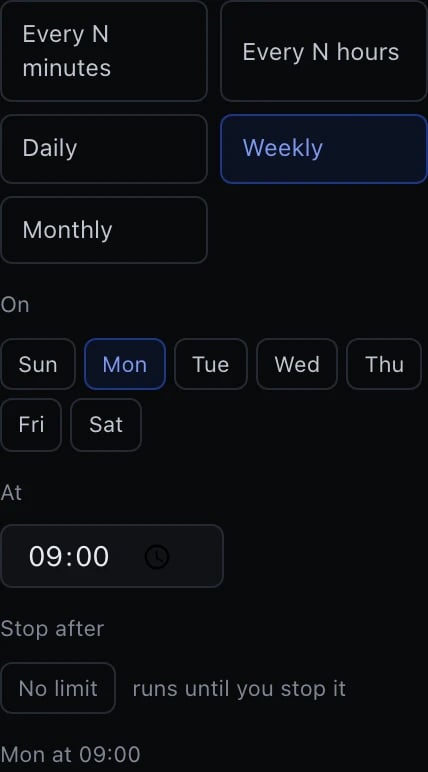
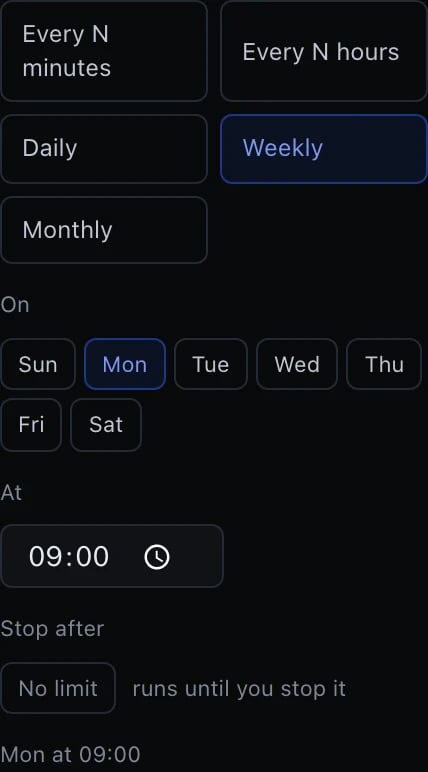 The line under the controls always spells out what the current choice means, so
you are never guessing at a cron expression you cannot see.
### 4. Optionally stop after N runs
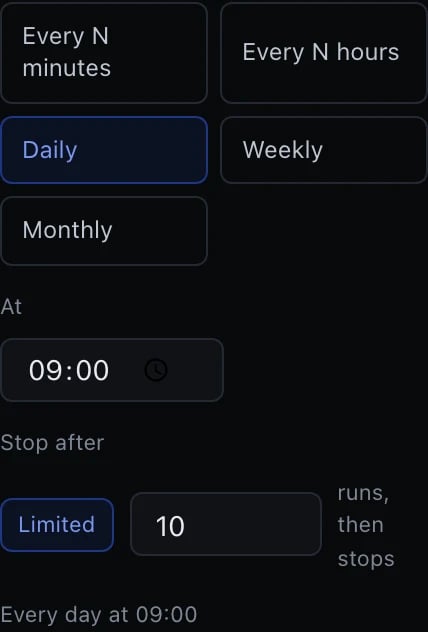
**Stop after** is *No limit* by default. Switch it to *Limited* and enter a number
to run "hourly, ten times".
The line under the controls always spells out what the current choice means, so
you are never guessing at a cron expression you cannot see.
### 4. Optionally stop after N runs
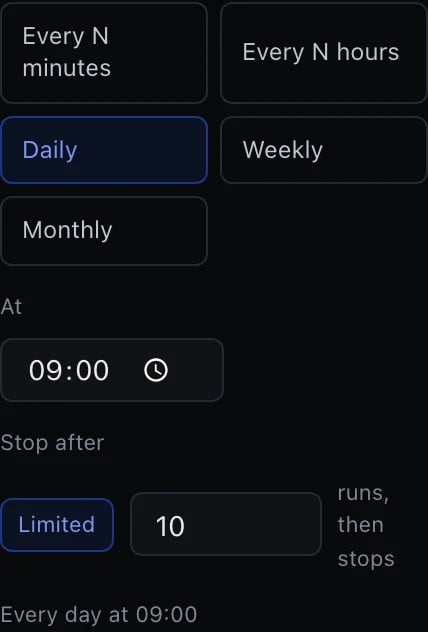
**Stop after** is *No limit* by default. Switch it to *Limited* and enter a number
to run "hourly, ten times".
 ### 5. Add it
Press **Add schedule**. The zone shown next to the button is the one the times are
read in — your browser's, unless you are using the API. The schedule is armed
immediately and appears in the list at the top of the same dialog.
### 5. Add it
Press **Add schedule**. The zone shown next to the button is the one the times are
read in — your browser's, unless you are using the API. The schedule is armed
immediately and appears in the list at the top of the same dialog.
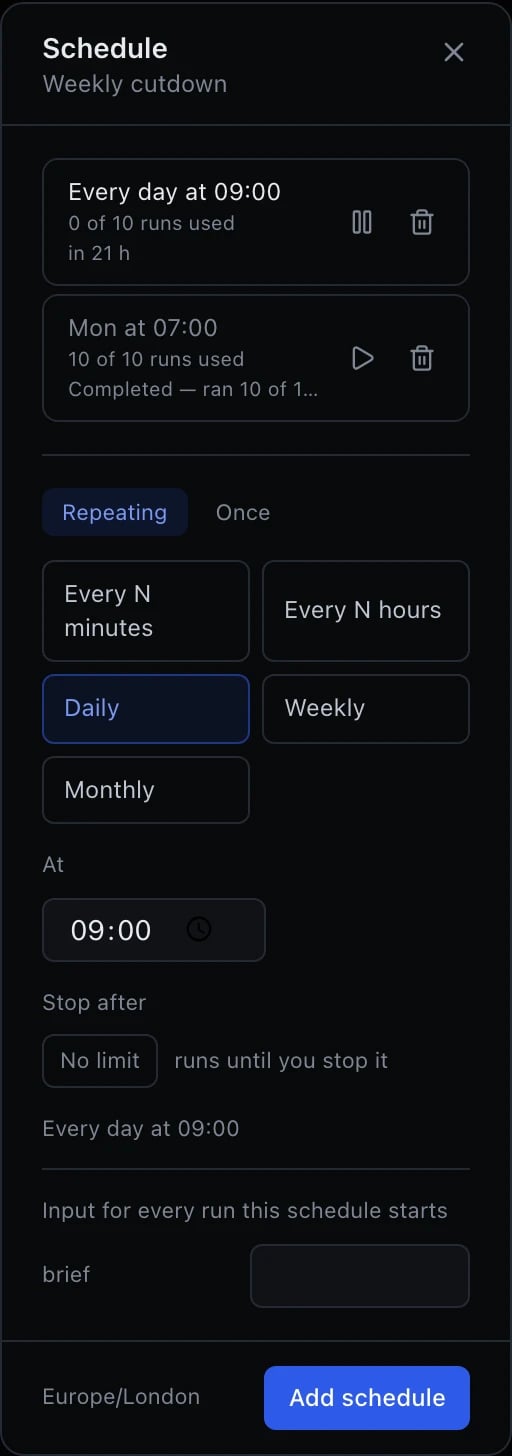
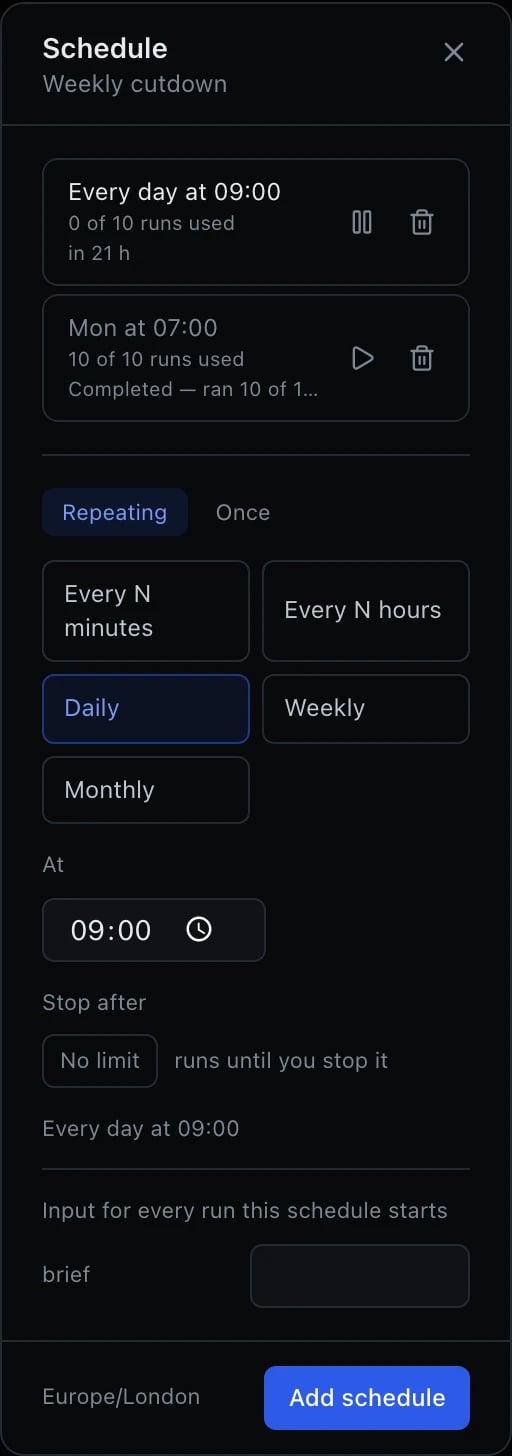 None of the shape buttons are greyed out in that shot: the workspace is on
**Team**, whose floor is one run every five minutes — below anything the form
offers. **Add schedule** is enabled because this workflow's only input, `brief`,
carries no required flag.
### The input its runs are given
If the workflow declares inputs, the dialog asks for them — the same fields the
run drawer shows, with the same required-ness.
Leave a field blank and the key is **omitted**, so the workflow's own default
applies at run time. That is deliberate: a schedule that copied today's default
would keep it for ever, and changing the workflow next month would leave every
older schedule quietly on the old value.
A **required** input with no default has to be filled in — a schedule cannot ask
you for it at 03:00, so **Add schedule** stays disabled until it has one, and
says which field it is waiting for.
Media inputs take a **URL**, not an upload: the run fetches it each time it
fires.
## Managing them
Everything lives in the same dialog. Each schedule in the list shows what it does
and when it next runs, with two controls:
* **Pause / Resume** — stops it firing without deleting it. Resuming re-checks
your plan and quota, so you are told immediately if either now refuses, rather
than watching it switch itself off a minute later.
* **Delete** — removes it. Runs it already started are untouched.
A workflow can carry several schedules at once — a daily one and a Monday-morning
one, say.
## Seeing that it ran
Scheduled runs are ordinary runs. They appear in the workflow's **run history**
in the sidebar, alongside the ones you started by hand, and cost the same
credits.
If a schedule stops itself, the workflow is marked in the sidebar list — on every
tab, not only under **Scheduled**. Open the schedule to read why.
## The two kinds
| Kind | Behaviour |
| ------------- | ----------------------------------------------------------- |
| **Repeating** | Fires on a recurring pattern until you turn it off. |
| **Once** | Fires one time at an instant you pick, then retires itself. |
Every schedule stores an **input** — the object your `${input.…}` bindings read.
It is stored because nobody is awake at 03:00 to type it.
A repeating schedule is built from a shape and a time — every N minutes, every N
hours, daily, on chosen weekdays, or on a day of the month — rather than from a
raw cron expression. The intervals offered are the ones that divide their field
evenly: a five-hour step would fire at 00:00, 05:00, 10:00, 15:00, 20:00 and then
at 00:00 again, a **four**-hour gap, so it would not mean what it says.
A one-time schedule cannot be set in the past. The picker will not offer an
earlier instant, and a time typed in by hand is refused as well.
### Stopping after N runs
A repeating schedule can carry a **run limit**: "hourly, ten times". By default
there is none, and that is deliberate — an invented ceiling would stop a schedule
one morning for a reason nothing on screen explains.
The limit counts runs **started**, not workflows that succeeded. A retry after a
failure to start does not spend the allowance; otherwise a provider outage would
quietly eat a customer's ten runs.
Reaching the limit retires the schedule the same way a one-time schedule retires:
it is **completed**, not broken, so it is not flagged as a problem. Resuming one
that has already spent its allowance is refused with
`schedule_run_limit_reached` — raise the limit or remove it in the same edit and
it resumes. Without that refusal it would fire exactly once more and stop again,
which reads as the resume simply not working.
A schedule also stores a **timezone**, and stores it rather than resolving it
once. A schedule set to 09:00 in `Europe/Berlin` stays at 09:00 across the
daylight-saving change, which is what people mean by "every morning". A schedule
pinned to UTC would appear to drift by an hour twice a year.
## What you are allowed to schedule
Two limits apply, and they are different questions with different answers.
**Does your plan include scheduling?** It is available on **Creator and above**. On a
lower plan the scheduling controls are shown but disabled, and say so. Nothing you
configure changes it — it is a plan feature.
**How often may it run?** Each plan sets a floor on the interval, and options that
fire more often are greyed out rather than hidden, so you can see what an upgrade
would buy.
| Plan | Shortest interval |
| -------------- | ----------------- |
| **Creator** | every hour |
| **Studio** | every 15 minutes |
| **Team** | every 5 minutes |
| **Enterprise** | every minute |
One minute is the hard floor regardless — schedules are swept once a minute.
The floor is measured against the **smallest real gap** a pattern produces, not
against how it looks: a pattern with a twenty-minute gap in it is a twenty-minute
schedule, even if it only fires three times a day.
A schedule that breaks the floor is **refused, never quietly slowed** — clamping it
would leave the dashboard reporting one frequency while running another.
Individual members and API keys can also be denied scheduling through a
[quota](/workspaces/quotas-and-presets), regardless of the plan. That refusal is
not something an upgrade fixes; ask a workspace administrator.
None of the shape buttons are greyed out in that shot: the workspace is on
**Team**, whose floor is one run every five minutes — below anything the form
offers. **Add schedule** is enabled because this workflow's only input, `brief`,
carries no required flag.
### The input its runs are given
If the workflow declares inputs, the dialog asks for them — the same fields the
run drawer shows, with the same required-ness.
Leave a field blank and the key is **omitted**, so the workflow's own default
applies at run time. That is deliberate: a schedule that copied today's default
would keep it for ever, and changing the workflow next month would leave every
older schedule quietly on the old value.
A **required** input with no default has to be filled in — a schedule cannot ask
you for it at 03:00, so **Add schedule** stays disabled until it has one, and
says which field it is waiting for.
Media inputs take a **URL**, not an upload: the run fetches it each time it
fires.
## Managing them
Everything lives in the same dialog. Each schedule in the list shows what it does
and when it next runs, with two controls:
* **Pause / Resume** — stops it firing without deleting it. Resuming re-checks
your plan and quota, so you are told immediately if either now refuses, rather
than watching it switch itself off a minute later.
* **Delete** — removes it. Runs it already started are untouched.
A workflow can carry several schedules at once — a daily one and a Monday-morning
one, say.
## Seeing that it ran
Scheduled runs are ordinary runs. They appear in the workflow's **run history**
in the sidebar, alongside the ones you started by hand, and cost the same
credits.
If a schedule stops itself, the workflow is marked in the sidebar list — on every
tab, not only under **Scheduled**. Open the schedule to read why.
## The two kinds
| Kind | Behaviour |
| ------------- | ----------------------------------------------------------- |
| **Repeating** | Fires on a recurring pattern until you turn it off. |
| **Once** | Fires one time at an instant you pick, then retires itself. |
Every schedule stores an **input** — the object your `${input.…}` bindings read.
It is stored because nobody is awake at 03:00 to type it.
A repeating schedule is built from a shape and a time — every N minutes, every N
hours, daily, on chosen weekdays, or on a day of the month — rather than from a
raw cron expression. The intervals offered are the ones that divide their field
evenly: a five-hour step would fire at 00:00, 05:00, 10:00, 15:00, 20:00 and then
at 00:00 again, a **four**-hour gap, so it would not mean what it says.
A one-time schedule cannot be set in the past. The picker will not offer an
earlier instant, and a time typed in by hand is refused as well.
### Stopping after N runs
A repeating schedule can carry a **run limit**: "hourly, ten times". By default
there is none, and that is deliberate — an invented ceiling would stop a schedule
one morning for a reason nothing on screen explains.
The limit counts runs **started**, not workflows that succeeded. A retry after a
failure to start does not spend the allowance; otherwise a provider outage would
quietly eat a customer's ten runs.
Reaching the limit retires the schedule the same way a one-time schedule retires:
it is **completed**, not broken, so it is not flagged as a problem. Resuming one
that has already spent its allowance is refused with
`schedule_run_limit_reached` — raise the limit or remove it in the same edit and
it resumes. Without that refusal it would fire exactly once more and stop again,
which reads as the resume simply not working.
A schedule also stores a **timezone**, and stores it rather than resolving it
once. A schedule set to 09:00 in `Europe/Berlin` stays at 09:00 across the
daylight-saving change, which is what people mean by "every morning". A schedule
pinned to UTC would appear to drift by an hour twice a year.
## What you are allowed to schedule
Two limits apply, and they are different questions with different answers.
**Does your plan include scheduling?** It is available on **Creator and above**. On a
lower plan the scheduling controls are shown but disabled, and say so. Nothing you
configure changes it — it is a plan feature.
**How often may it run?** Each plan sets a floor on the interval, and options that
fire more often are greyed out rather than hidden, so you can see what an upgrade
would buy.
| Plan | Shortest interval |
| -------------- | ----------------- |
| **Creator** | every hour |
| **Studio** | every 15 minutes |
| **Team** | every 5 minutes |
| **Enterprise** | every minute |
One minute is the hard floor regardless — schedules are swept once a minute.
The floor is measured against the **smallest real gap** a pattern produces, not
against how it looks: a pattern with a twenty-minute gap in it is a twenty-minute
schedule, even if it only fires three times a day.
A schedule that breaks the floor is **refused, never quietly slowed** — clamping it
would leave the dashboard reporting one frequency while running another.
Individual members and API keys can also be denied scheduling through a
[quota](/workspaces/quotas-and-presets), regardless of the plan. That refusal is
not something an upgrade fixes; ask a workspace administrator.
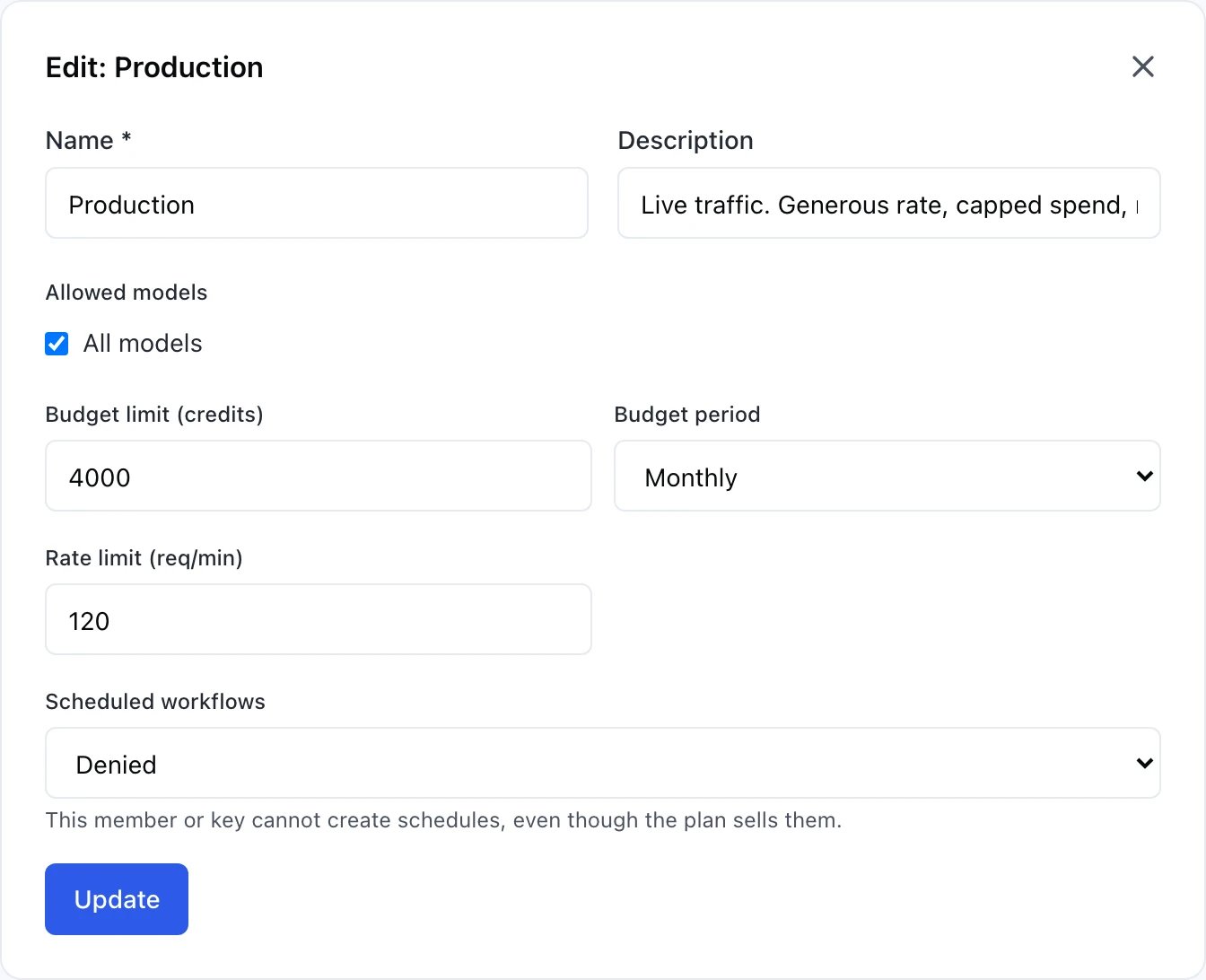
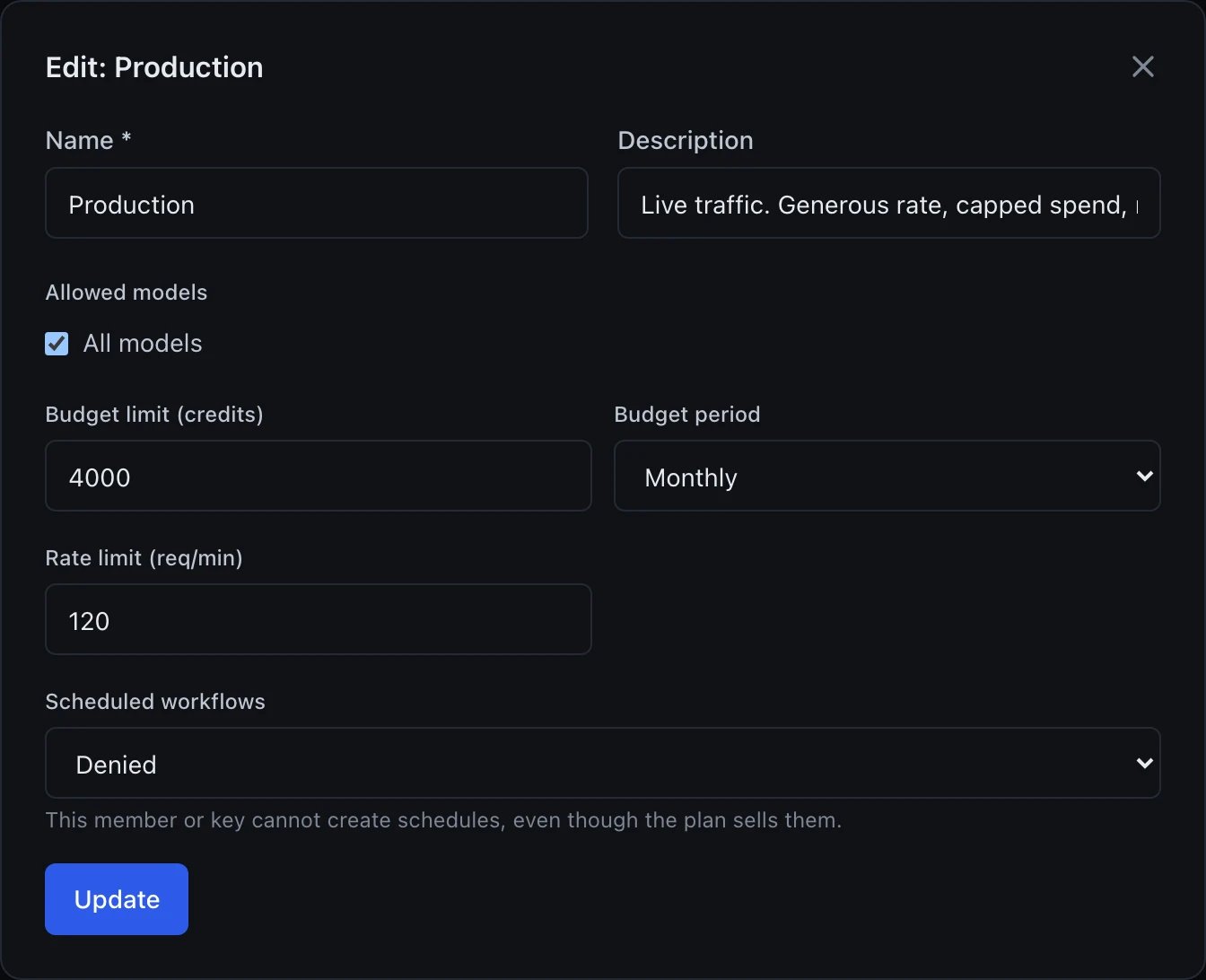 The control has **three** states, not two. *Inherit* leaves the preset silent so
the plan and any preset applied before it decide; *Allowed* overrides a denial
from an earlier one; *Denied* is the refusal above. A preset that says nothing is
not the same as one that says yes, and only the first can be overridden later.
Creating a schedule needs the same permission as **editing** the workflow. A
schedule spends credits later and unattended, so read access is not enough.
## What turns a schedule off
Every schedule is re-checked at **each** tick, not only when it was created. That is
deliberate: a schedule outlives the session that made it, and a timer left running
after its conditions changed keeps spending credits nobody authorised.
| Reason | What happened |
| ---------------------------------- | -------------------------------------------------------------------------------------------- |
| Author lost access | The person who created it is no longer an active member of the workspace. |
| Plan no longer includes scheduling | The subscription was downgraded. |
| Below the plan's floor | The floor moved above this schedule's frequency. |
| Quota forbids it | Its creator's quota no longer permits scheduling. |
| Invalid schedule | The pattern stopped parsing. No retry can fix this. |
| Too many failures | Five consecutive attempts failed to start a run. |
| Completed | A one-time schedule ran, or a repeating one reached its run limit. **Neither is a failure.** |
A schedule that stopped for any reason except the last one is **marked in the
workflows list itself**, on every tab — not only under **Scheduled**. A stopped
timer is something you should meet where you already are, rather than something to
go looking for. A one-time schedule that simply finished is not marked, because a
mark that fires on success is a mark people learn to ignore.
### Retries
A failure to *start* a run is retried with exponential backoff and jitter, and a
retry never lands later than the occurrence that was coming anyway — a daily report
that fails at 07:00 retries within minutes, not tomorrow. After five consecutive
failures the schedule turns itself off: a timer that fails forever is worse than one
that stops, because nobody reads a log and each attempt may be costing a hold.
A workflow that fails **after** it started does not count towards that limit. "We
could not start it" and "it ran and failed" are different problems, and only the
first is the schedule's fault.
## Finding your schedules
The workflows sidebar has a **Scheduled** tab listing every workflow that has a
schedule — yours and ones shared with you. It is a filter across the whole list
rather than a third category, so a scheduled workflow still appears under **Mine**
or **Shared** as well.
The control has **three** states, not two. *Inherit* leaves the preset silent so
the plan and any preset applied before it decide; *Allowed* overrides a denial
from an earlier one; *Denied* is the refusal above. A preset that says nothing is
not the same as one that says yes, and only the first can be overridden later.
Creating a schedule needs the same permission as **editing** the workflow. A
schedule spends credits later and unattended, so read access is not enough.
## What turns a schedule off
Every schedule is re-checked at **each** tick, not only when it was created. That is
deliberate: a schedule outlives the session that made it, and a timer left running
after its conditions changed keeps spending credits nobody authorised.
| Reason | What happened |
| ---------------------------------- | -------------------------------------------------------------------------------------------- |
| Author lost access | The person who created it is no longer an active member of the workspace. |
| Plan no longer includes scheduling | The subscription was downgraded. |
| Below the plan's floor | The floor moved above this schedule's frequency. |
| Quota forbids it | Its creator's quota no longer permits scheduling. |
| Invalid schedule | The pattern stopped parsing. No retry can fix this. |
| Too many failures | Five consecutive attempts failed to start a run. |
| Completed | A one-time schedule ran, or a repeating one reached its run limit. **Neither is a failure.** |
A schedule that stopped for any reason except the last one is **marked in the
workflows list itself**, on every tab — not only under **Scheduled**. A stopped
timer is something you should meet where you already are, rather than something to
go looking for. A one-time schedule that simply finished is not marked, because a
mark that fires on success is a mark people learn to ignore.
### Retries
A failure to *start* a run is retried with exponential backoff and jitter, and a
retry never lands later than the occurrence that was coming anyway — a daily report
that fails at 07:00 retries within minutes, not tomorrow. After five consecutive
failures the schedule turns itself off: a timer that fails forever is worse than one
that stops, because nobody reads a log and each attempt may be costing a hold.
A workflow that fails **after** it started does not count towards that limit. "We
could not start it" and "it ran and failed" are different problems, and only the
first is the schedule's fault.
## Finding your schedules
The workflows sidebar has a **Scheduled** tab listing every workflow that has a
schedule — yours and ones shared with you. It is a filter across the whole list
rather than a third category, so a scheduled workflow still appears under **Mine**
or **Shared** as well.

 The icon on the row says which state the schedule is in — running, idle, or
stopped — and it appears on **every** tab, not only this one.
Pausing a schedule and turning it back on are both in the same dialog. Turning one
back on **re-checks the limits above**: if the plan or the quota is still refusing,
you are told there and then, rather than watching it switch itself off a minute
later.
The icon on the row says which state the schedule is in — running, idle, or
stopped — and it appears on **every** tab, not only this one.
Pausing a schedule and turning it back on are both in the same dialog. Turning one
back on **re-checks the limits above**: if the plan or the quota is still refusing,
you are told there and then, rather than watching it switch itself off a minute
later.